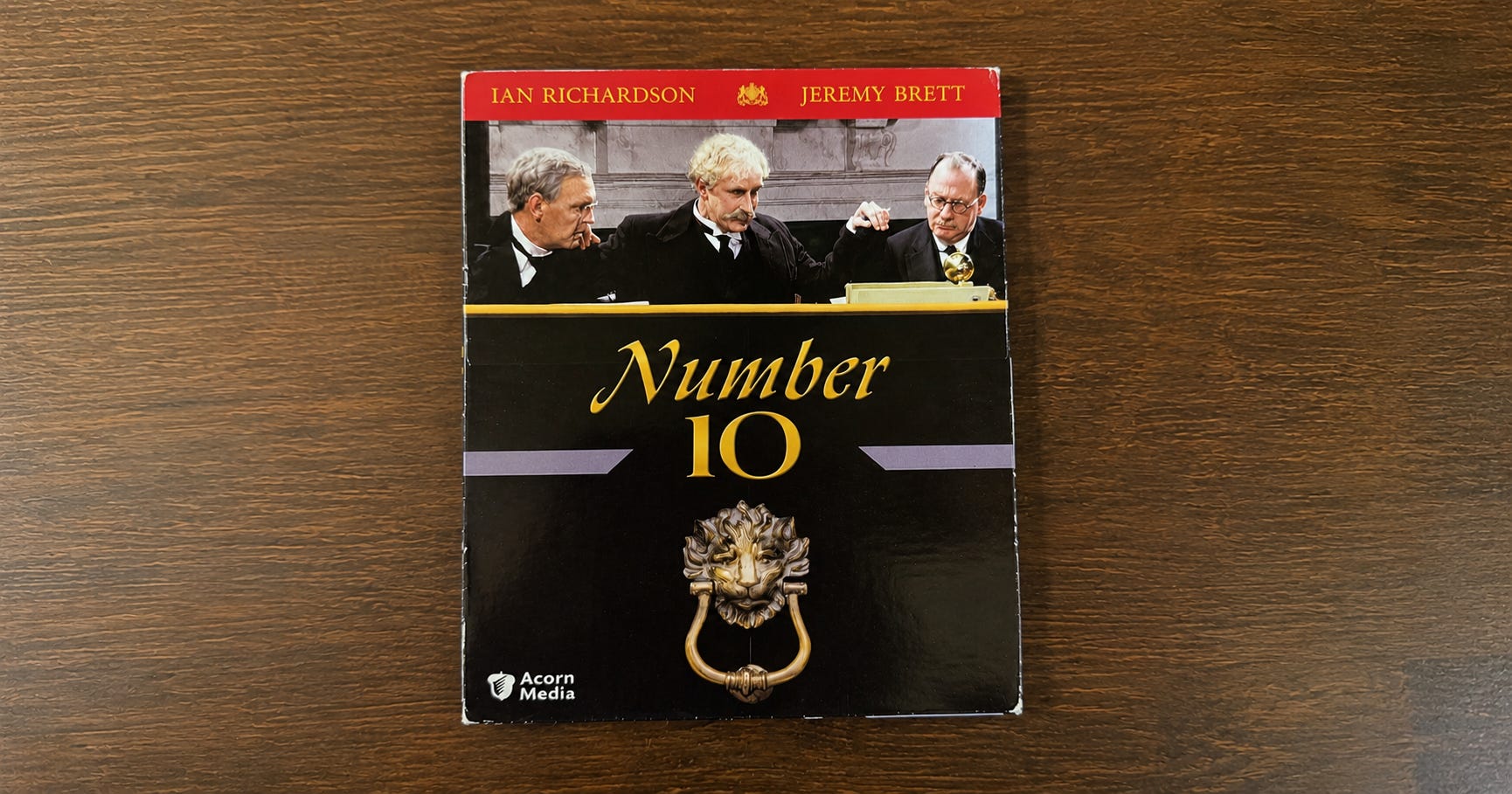
William Ewart Gladstone ranked second, third or fourth on all five of the lists of the best prime ministers in UK history that are cataloged on Wikipedia, which includes lists compiled by The Times of London and four prominent historians. But as I noted in a blog post last year, Gladstone has never been the subject of a movie, unlike Winston Churchill, who ranks first on all of the lists, and Benjamin Disraeli, who ranks considerably lower. There is however one filmed representation of Gladstone, a fifty-minute episode of a 1983 ITV television series called “Number 10,” named for the home of the Prime Minister at Number 10 Downing Street. This month I managed to find a copy of an NTSC DVD of the series, which I’d struggled to find when I wrote that article. The show presents a character study of seven prime ministers that is unmatched by anything comparable on American television.
The first episode makes a solid case that Gladstone’s story is interesting enough to merit dramatic treatment. It focuses on the splashiest subject in Gladstone’s biographies, namely his habit of “night walks” on which he picked up sex workers and brought them back to Number 10 Downing Street, allegedly to reform them under the aegis of an organization called the Church Penitentiary Association of the Reclamation of Fallen Women. The $60,000 question has always been whether Gladstone, who spent time alone with these women, was really driven by altruistic motives, or whether the night walks were an elaborate cover for a simple predilection for something seamier. The episode raises that question, lets us ponder the evidence for 35 minutes, and then finally proposes its own answer: Gladstone was tortured by temptation, and was pushing that boundary, but never gave in. The show’s climax is plausibly argued. We know Gladstone to have been plagued by a hyperactive Christian conscience, marking in his diary instances of flogging himself for what can therefore rightly be known as self-abuse. The actor who plays Gladstone, Denis Quilley, looks just like the historical Gladstone, and his energetic, pompous, bombastic manner plays like a plausible read on the Grand Old Man’s demeanor. The episode is one of the best of the seven in the series, each of which covers a different prime minister.
Where the Gladstone episode is intriguing for the psychological study it includes, the episode dedicated to Benjamin Disraeli is fascinating for an element of psychology it excludes. The Disraeli segment is interesting in part from the standpoint of queer studies, not because it depicts him as gay but because its subject raises interesting questions for those inclined to interpret him that way. Disraeli was prime minister twice: The first time was brief, less than a year in duration, and the second time, which lasted much longer, he was in his seventies. The “Number 10” episode, entitled “Dizzy,” brings us the latter Disraeli, a septuagenarian who was nonetheless engaged in wooing two women at once. One of them, a very much married Lady Selina Bradford, received literally 1,100 letters from Disraeli. The other woman was Lady Bradford’s sister, Lady Chesterfield, to whom Disraeli proposed marriage specifically as a way of getting closer to Selina. Lady Chesterfield, who received 500 letters from Disraeli, turned him down. (Ah, but who wouldn’t have found such a proposal charming?) The letters are catalogued in a two-volume book from 1929 entitled The Letters of Disraeli to Lady Bradford and Lady Chesterfield. Biographer Robert Blake says these letters are among the great sources not only for Disraeli’s biography but for “the times until Disraeli’s death” in 1881. Blake’s characterization in his 1966 biography Disraeli of the prime minister as having ‘fallen head over heels in love with Lady Bradford” is interesting given that in a later book (Disraeli’s Grand Tour, his travelogue of Disraeli’s youthful trip through what the British called “the East” or “the Orient”) the same Blake says that his relationship with another woman named Henrietta Sykes was “the only real love in his life.” Blake also notes that “it is difficult to avoid the impression that, although flattered at the attention, and delighted to be ‘in the know,’ [Lady Bradford] never really cared for him much.” However, Blake does not speculate, as do Kuhn and Buckle, on just how passionate Disraeli’s attraction to Bradford was.
Still, because Disraeli was a prominent dandy, a prototype for the aesthetes of Oscar Wilde’s day who was openly admired and emulated by the great dramatist, questions about his sexuality have always followed him. Biographer William Kuhn wrote a study of his sexuality titled The Politics of Pleasure in 2006, pointing out for example that Gladstone’s rhetoric against Disraeli sometimes flirted with accusation of homosexuality. Kuhn presents Disraeli as a man with an orientation “out of the ordinary,” recognized to some extent by some who knew him. Disraeli was a puzzle to our modern stereotypes: He was a flamboyant dresser with close platonic relationships with women and few but passionate, intense relationships with (especially younger) men; a man who famously married a much older woman for her money (but who, she said, would do it again for love). In what he described as an autobiographical novel, Contarini Fleming, Disraeli had his lead character explore a “love” relationship in his school days with a boy named Musaeus, in an anecdote so detailed and odd that historical novelist Maurice Edelman went so far as to depict it as a real event in Disraeli’s life. So, the modern reader might be initially puzzled by his ardor towards the 55-plus-year-old Lady Bradford. As early as 1920, seminal biographer George Buckle wrote that “Disraeli’s chivalrous devotion to women was independent of physical attraction and the appeal of youth … It is a most honourable feature in his composition that, in relation to women, as in his relation to the problems of life and eternity, he rejected absolutely any physical or sensuous standard, and poured out his devotion before an ideal, regardless of the ravages of care and time.” This language, were Disraeli not interpreted as gay, might be considered offensive: Fifty-five is, after all, pretty young to a 70-year-old, and “the ravages of care and time” is an extreme description of so young a woman even in Victorian times when life expectancies were much lower. But descriptions of Disraeli as interested intellectually in women but not physically stretch back further than that. The granddaughter of Disraeli’s contemporary Lady Londonderry wrote that “for Disraeli Woman was the perfect companion, and it is remarkable that the pleasure he experienced in female society was largely intellectual and often quite independent of physical attraction.” Kuhn, after quoting this, adds “That someone could have recognized this about him so close to his own generation is evidence that Disraeli’s contemporaries knew that Disraeli’s orientation to the opposite sex was out of the ordinary.”
Richard Pasco plays Disraeli with a robust zeal that seems directly influenced by George Arliss’s Oscar-winning 1929 portrayal, though with more realism. The episode deftly juxtaposes Disraeli’s courting of Lady Bradford and Lady Chesterfield with the other woman in Disraeli’s life at this time: Queen Victoria, played with convincing restraint by Zena Walker. The attempt to replace Disraeli’s beloved wife Mary Anne Disraeli, who died in 1872, is depicted sensitively if somewhat puzzlingly: We never quite see what Disraeli sees in either Lady Bradford or her sister.
The other episodes in the “Number 10” series, all written by Terence Feely, author of a book about the personal lives of the prime ministers that bears the same title, are equally fascinating capsules in British history. Seeing Ramsay MacDonald, the first Labour Prime Minister, struggle to furnish “Number 10” because he can’t afford it is as instructive in British politics as anything in the series. That’s why there’s been three generations of Tory governments, MacDonald observes in the teleplay: No one else could afford to be prime minister. The episode on Asquith seizes on a story too little told on this side of the pond at least: the extraordinary battle with the House of Lords that was necessary to the passage of the revolutionary People’s Budget, which instituted a progressive income tax and established a safety net for the poor and elderly. Also featured are David Lloyd George, Arthur Wellesley the Duke of Wellington, and William Pitt the Younger. Nothing quite so entertainingly concise has been produced for American television on the comparable figures in US political history.