Writing about Benjamin Disraeli as an American, as I do, can be lonely. The 19th century British prime minister and 12-time novelist’s only recent appearance in the American pop consciousness came in a cameo on the animated television show “The Family Guy.” In one of the show’s famous cutaway gags Disraeli turns to the TV audience and intones dolefully “You don’t know who I am.”
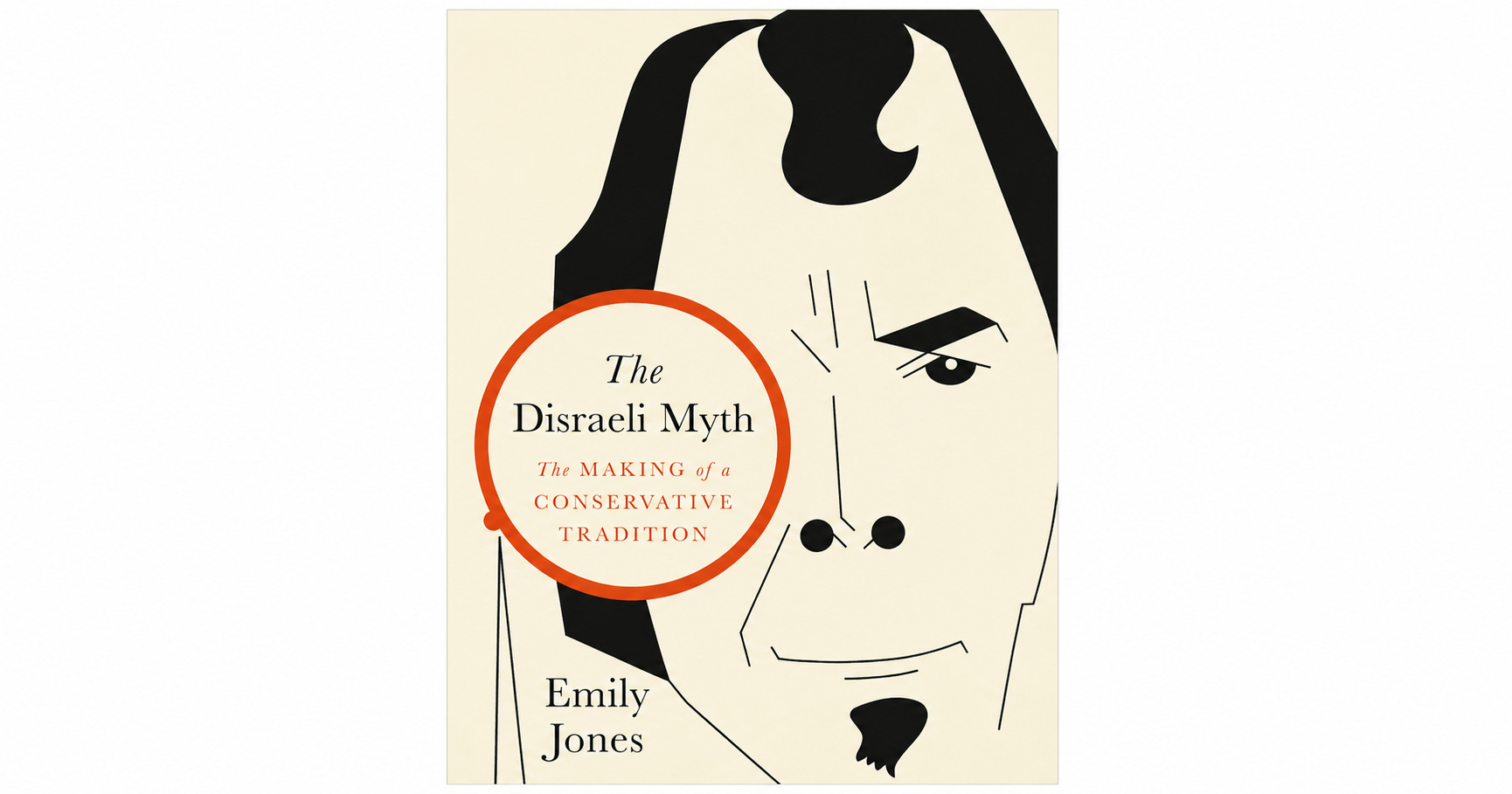
That walk-on is mentioned by Emily Jones in the opening pages of her excellent new book The Disraeli Myth: The Making of a Conservative Tradition. But Jones cites it as evidence of Disraeli’s continued relevance and leaves out the point of the bit: Disraeli is passé. This is a lesson I also learned when I tried to sell my near mint copy of a scholarship-packed edition of Disraeli’s first novel Vivian Grey at a hip used bookstore in Chicago’s Wicker Park neighborhood. The bookstore employee offered me a quarter of its sticker price and explained, with a look of remorseful pity, “Not too many people are looking for Disraeli novels these days.” The last I knew, it was still there, marked $30, next to a copy of his novel Coningsby. A Reddit thread about 300 days ago, not by me, asked, “Why isn’t Benjamin Disraeli lionized anymore?” I, too, tried interesting the literary crowds on Reddit in the 200th anniversary of Vivian Grey and, while I received 8,000 views and several “upvotes” not one person commented on my post, unlike other posts of mine.
Jones’ book, however, makes a case that Disraeli’s influence has remained surprisingly important in British politics. If she’s right, and I think she is, then Disraeli’s 1845 Sybil, or the Two Nations, which is brilliant but politically vague and inert, is perhaps the single most influential novel of all time on politics.
Thus Jones’ book suggests indirectly that there is an enduring power in fiction that is largely unrecognized and ignored. Tom Stoppard once said that he’s always felt the worst way to change the world is to write a play. But it is because of Sybil that British politicians still identify themselves today as “One Nation Conservatives,” including recent prime ministers Boris Johnson (2019-2022), Theresa May (2016-2019) and David Cameron (2010-2016). Sybil, or The Two Nations argued that Britain had become divided into a nation of the rich and a nation of the poor, and the phrase “one nation” suggests those two nations should be somehow united, though it’s rarely clear just how, either in the novel or in the rhetoric Jones lays out that followed. Jones points out Disraeli never used the term “One Nation Conservative,” or endorsed the vague mix of social reform and institutional conservatism it has implied at least since 1924, when prime minister Stanley Baldwin used the term in a speech. Hence Disraeli’s legacy is built not so much an history as on a myth.
Disraeli started his own myth
Sybil shows that the Disraeli myth was really started by Disraeli himself. Jones’ book could have outlined just how, but its focus is on the historical development of the myth in the succeeding years. The fact is that Disraeli reveled in the fact that no one could figure out where he was coming from politically. When he first emerged on the political scene in 1832 he was baffling enough to voters that he wrote a pamphlet titled “What is He?”, attempting in typically amorphous terms to answer the question that he asked in one of his novels: Was he liberal, or conservative? “Am I a Whig, or am I a Tory?”
In fact, he wrote a scene in Sybil in which a club full of political observers and participants react with that very question to a speech that his hero Charles Egremont has given in parliament, a speech Disraeli clearly based on one of his own speeches on a key issue of the day, the working-class Chartist’s petition for such reforms as universal suffrage at a time when only a sliver of the adult male population had the vote. Writing a novel is one way to fantasize about the ideal reactions one might receive to a speech. Here is what Disraeli fantasized in Sybil:
“It was very remarkable speech — that of Egremont,’ said the grey-headed gentleman. ‘I wonder what he wants.’
‘I think he must be going to turn Radical,’ said the Warwickshire peer.
‘Why the whole speech was against radicalism,’ said Mr. Egerton.
‘Ah, then he is going to turn Whig, I suppose.’
‘He is ultra anti-Whig,’ said Egerton.
‘Then what the deuce is he?’ said Mr. Berners.
‘Not a Conservative certainly, for Lady St. Julians does nothing but abuse him.’
‘I suppose he is crotchetty,’ suggested the Warwickshire noble.
‘That speech of Egremont was the most really democratic speech that I ever read,’ said the grey-headed gentleman. ‘How was it listened to?’
‘Oh! capitally,’ said Mr. Egerton. ‘He has very seldom spoken before and always slightly though well. He was listened to with mute attention; never was a better house. I should say made a great impression, though no one knew exactly what he was after.’”
This passage from Sybil shows the mythic enigma of Disraeli’s politics. Disraeli voted against the petition of the Chartists, who are the main force for the so-called nation of the poor in Sybil. His great contribution in the parliamentary debate on the Charter was to suggest that although he did not “approve of the remedy suggested by the Chartists, it did not follow that they should not attempt to cure the disease complained of.” He has Egremont take the same position, and once again it’s not his support for the Chartists but the inscrutability of his position that Disraeli celebrated in Sybil:
“’What does he mean by obtaining the results of the Charter without the intervention of its machinery?” enquired Lord Loraine …
“He spoke throughout in an exoteric vein,” said the grey-haired gentleman, ‘and I apprehend was not very sure of his audience; but I took him to mean, indeed it was the gist of his speech, that if you wished for a time to retain your political power, you could only effect your purpose by securing for the people greater social felicity.’”
Disraeli had a good point, surely, that to retain their goals the upper classes needed to make sacrifices, but that’s as far as Disraeli would go in Sybil to endorse the political cause of his book’s heroes Sybil and her father. In fact Egremont wins the love of Sybil on the basis of a rather tepid argument: That the people should rely on the political engagement of a young aristocratic class: “The future principle of England will not be a levelling principle; not a principle adverse to privileges, but favourable to their extension, It will seek to ensure equality, not by levelling the Few but by elevating the Many.’” It is with those uninspiring words that a climactic conversation ends between Sybil and Egremont, and by the next time they meet she has finally fallen in love with him.
Thus Sybil has always been a frustratingly inert book politically. One could argue its legacy has been simply to grant members of the conservative parties from both Britain and the USA permission to see themselves as magnanimous supporters of the poor. Richard Nixon and Henry Kissinger, for example, described themselves as Disraelian conservatives after Robert Blake’s 1966 biography Disraeli made the subject a hot one temporarily in both countries. But the book, and the resultant myth of One Nation Conservatism, also provoked conservatives to pursue social reforms they might ordinarily have ignored.
A revolutionary mind
Still, for its time Sybil was a mightily advanced argument for a Tory to make. Disraeli biographer Paul Smith wrote, on a page cited in a footnote in Jones’ book, that Benjamin “lived in an uneasy symbiosis” with the Tories: “At once its leader and its prisoner, he could not transform its character or reshape its thinking; he could only influence and modify its outlook and course.” I’d argue it was this quality of Disraeli as prisoner to the Tory party that cemented his image as lacking in principle, despite all the thousands of pages in which he spelled out his political philosophy. That inability to be straight about his ambitions for the poor and working class meant he had to straddle two political lines, the ultra-Tory and the Radical. It didn’t help that in his first novel Vivian Grey he painted a portrait of a politician as an unscrupulous young man, trying to intrigue his way to political heights. But when communicating with friends on the Left, he could reveal flashes of subversive intent. “I am much misunderstood,” Disraeli told famous “non-conformist” preacher turned Radical politician William Johnson Fox. “My forte is revolution.”
We don’t know exactly when he said that, but it wasn’t the first time he’d cast himself as a revolutionary. “My mind is a revolutionary mind. It is a continental mind,” Disraeli famously confessed to a diary in his youth. To date I’m the only writer I’ve found who has suggested that this curious phraseology might have been inspired by the headmasters at Disraeli’s school who, before he dropped out, described him as a “foreign and seditious mind, incapable of acquiring the spirit of the school.” In youth as in age, Disraeli embraced the enigma of his own myth.
Contrary to the representation by some conservative historians, I’d suggest Disraeli’s revolutionary spirit persisted at least as a burning force beneath his ultra-Toryism. And it wasn’t just when talking to the Left that he bashed the Right. “While affecting to be anti-Whig,” historian John Vincent wrote of his first political novel Coningsby, “it was in reality venomously anti-Tory. By restricting true Toryism to a definition peculiar to the author, all actual Tories were placed firmly in the wrong. Coningsby may enrich the inheritance of every educated Englishman; it cannot gladden the Tory heart.” It’s easy to forget that Coningsby’s young conservative heroes advocated emphatically for a position apart from either Whig or Tory lines. Those heroes were based on the faction of the Tory party into which Disraeli had fallen, and which he led in the 1840s, “Young England.” It’s this “revolutionary” spirit in “Young England” that perhaps caused Friedrich Engels in his 1845 book The Condition of the Working Class in Britain to characterize them as “philanthropic Tories” whose “feudal socialism” is “worth something anyhow,” despite his complaints with it:
“The hope of ‘Young England’ is a restoration of the old ‘merry England’ with its brilliant features and its romantic feudalism. This object is of course unattainable and ridiculous, a satire upon all historic development; but the good intention, the courage to resist the existing state of things and prevalent prejudices, and to recognize the vileness of our present condition, is worth something anyhow.”
So how did the revolutionary instinct of Sybil translate into action when Disraeli reached the top of what he called “the greasy pole” of politics? When Disraeli finally fulfilled his childhood ambition of becoming prime minister, he was reportedly old, sick with gout and without ideas. As Jones points out, it was his home secretary, R.A. Cross, who instituted the social reforms that have become part of the legend of One Nation Conservatism: “Social legislation tackling housing, factory work, sanitation, and trade unions.” Thus a tepidly revolutionary novel led to a smattering of genuine reforms. It was these policies that became the basis for the argument that the Tory party was the true home for national reform.
Jones traces the influence of a consequential man
To her credit, Jones does not write another biography of this, or any other, Disraeli. The Myth of Disraeli attempts to chart “how, why and when” Benjamin Disraeli’s reputation was “established in Britain, how it was subsequently adapted, and to what substantial uses it has been put.” She acknowledges that “since the 1960s a growing body of scholarship has sought to explode, first the ‘myth’ of Disraeli the democratizing social reformer, and second the notion of a timeless ‘One Nation’ tradition which can be seamlessly traced from Disraeli to later One Nation Conservatives.” Then she charts that myth from the years Disraeli lived to the present day. She begins by cataloguing “impressions of Disraeli” in Hollywood and elsewhere in media, and how they altered the myth. In the second chapter she explores what Randolph Churchill called “Tory Democracy,” another term flattering to Disraeli’s philosophy like “One Nation Conservatism” that emerged after his death. After the 1884-85 Reform Acts, which furthered Britain on its slow path to democracy by expanding the electorate, “there was a struggle to define terms such as ‘democracy’, ‘the democracy’ and ‘democratic government,’” Jones writes. Tory Democracy from the early 1880s “was associated with various forms of ‘progressive’ Conservatism that adopted a more flexible and relaxed approach towards increasing democratization in the political sphere.”
Later in the book a chapter is devoted to the seemingly (as Jones points out) oxymoronic concept of “Tory Socialism.” When the implementation of democracy in Britain introduced for the first time a battle for the vote of the working man, a whole new concept of the role of each party necessarily had to emerge. Disraeli, after his death, was credited with spotting (as a sculptor spots an angel in a block of marble, the London Times remarked) the working-class Tory voter. His 1866 Reform Act, which expanded the vote beyond that which the Liberal bill had done, was credited with this. And indeed, winning the new voters to Toryism was one of Disraeli’s famously inscrutable motives for championing that bill. (It didn’t immediately work, we know, as Gladstone and the Liberal Party rode to victory just a few months after Disraeli’s bill enfranchised these new voters). In any case, it made the concept of Tory Socialism possible in succeeding decades. Naturally those who advocated this amorphous concept credited Disraeli as inspiration.
The third chapter, which focuses on Sybil, is the most interesting. It explores the critical reception to the book Sybil and the path it took to this strange political longevity, or as she puts it “the rise and institutionalization of historicist English literature as a discipline that could be studied along strictly historical lines.” She notes that English literature was only just beginning to be studied, and tracks the critical reception to the book. More than one quoted scholar congratulates Disraeli’s wisdom in, as Saturday Review critic Arthur Baumann wrote in 1930, “selecting the novel as the vehicle of his political principles.”
Tracing Sybil’s contribution as the most politically consequential novel of all time, as she does implicitly, is a great contribution to the literature on Disraeli. I know of only one other book that attempts to measure the impact of Sybil on actual political outcomes. That slim volume, Sheila M. Smith’s 1966 Mr. Disraeli’s Readers, reprinted several letters to Disraeli recounting their reactions to the novel. Some were from working class readers and one was from the improbably named Rev. Jonathan James Toogood, who informed the author of Sybil that his book had inspired the construction of St. Alban’s Church, “built for the poor of a crowded district in Holburn,” Smith notes. She says that this “scrap of evidence of the practical effect of a social problem novel” is “something of a find.” “It is difficult to assess how effective the social problem novels of the 1840s and early 1850s were in changing public opinion and making people act,” Smith writes.
By explicating the path of Sybil to the modern-day “One Nation Conservatism,” Jones provides more than a scrap of evidence, both of the real-world impact of the book and of the specific shape of Disraeli’s myth. It was Michael Foot, a liberal writing sympathetically of Disraeli in 1980, who suggested that enigmatic myth was paradoxical as it came after so much self-revelation on Disraeli’s part:
“One irony of the situation is that we have, and have always had, a better chance of dissecting the mind of Disraeli, alien or not, than any other Prime Minister in our history. Winston Churchill is the only conceivable rival in this claim; he poured out his thoughts, in books, letters and writings of every variety in such a superabundant profusion that we may be excused for supposing that no secrets remain. But who else? … No other leading politician, let alone a Prime Minister, has left a literary treasure to compare with Disraeli’s dozen or so novels. What a wonder it would be, to press the point further, if say, Lloyd George or Charles James Fox had possessed a similar gift.”
The trivial side of Disraeli
Sybil is of course not the only way in which Disraeli made his impact. Not all of Disraeli’s copious writings were political. In addition to his many “silver fork novels,” which attempted to tell stories first from an outsider’s and then from a partial insider’s perspective of the great world of high society in a level of detail that included the style of the silverware, his letters too were fascinating and eloquent but often devoid of political content. Disraeli’s letters were celebrated for being “trivial” by no less notable a trivialist than Oscar Wilde, in a review of the first printed edition of those epistles. And while Disraeli’s political philosophy was spelled out with great historical sweep, his interpretation of history was suspect even to conservatives. As Foot put it:
“If the Whig interpretation of history was a caricature, the Disraeli reinterpretation was something much worse, much cruder still, which, apart from its intrinsic evil, has jeopardised the credibility of all subsequent and genuine Conservative essays in the same field. At the time when he did it, the attempt to make a Tory patron-saint-cum-prophet out of the free-thinking roué and rogue, Lord Bolingbroke, deeply and inevitably offended Victorian sentiment. How could anyone so intelligent contrive a theme so implausible?”
Over the years mythic Disraeli’s role in the party was somewhat exaggerated by some. Jones’ prior (and first) book, titled Edmund Burke and the Invention of Modern Conservatism, 1830-1914: An Intellectual History, argued that Burke did not found modern conservatism, but that the label of founder was applied to him at the turn of the 20th century. In The Disraeli Myth, Jones traces the same kind of trajectory for Disraeli. She cites Paul Smith in saying Disraeli did not play the founding role either. “He did not found modern Conservatism,” Smith wrote. “Indeed, in destroying Peel, he had retarded its main line of development, the absorption of the bourgeoisie, by some twenty years. What he did was to assist its gestation, and facilitate its achievement of some kind of modus vivendi with the working classes.”
Still, the impact is undeniable. Sometimes One Nation Conservatives have operated in the party’s opposition, as in the era Margaret Thatcher, who spoke fleetingly in the Disraelian language of “one nation” but firmly favored Gladstonian fiscal conservatism and attacked the parliamentarians who actually called themselves One Nation Conservatives as “the wets.” More recently, those adopting the title have taken the lead. But the losses by the Tory party and the even more recent ascendence of the far right Reform UK Party have shown Disraeli’s waning influence on the right. In fact, Jones notes in her opening paragraphs that “One Nation Conservatism remains one of the most recognizable, if increasingly endangered, traditions within British political discussion and analysis.” (The emphasis is mine.)
A tradition in danger
That the tradition is endangered is a matter of consequence, too. Sybil’s inert attempt to address the problems of the poor is still nonetheless useful. The first review of Jones’ book, in The New Criterion by Simon Heffer, who sits in the House Lords, defines the One Nation tradition as “a sort of exaggerated care for the well-being of the poor.” Today’s era is increasingly being compared to Disraeli’s, with the potential for a new technological industrial revolution the near horizon that could dwarf the massive impact of the factories on the economy of his day. Heffer’s language in such a context seems frighteningly out of touch with reality. He is no fan of Disraeli’s (the piece is titled “An exalted opportunist” and favors the line that Disraeli was without principle). Whatever one thinks of the tepidness of Sybil’s or Disraeli’s government’s vaunted “care for the poor,” that quote puts in sharp relief the fact that some form of one nation conservatism is better than none at all. Hopefully Disraeli will not fade into the darkness for which the “Family Guy” sketch suggests he is destined, in which he must turn to us and admit, “You don’t know who I am.”
—
Correction: An earlier version of this essay stated incorrectly that Jones’ first book Edmund Burke and the Invention of Modern Conservatism, 1830–1914: An Intellectual History argued that Burke founded modern conservatism. In fact the book argues that the label of founder was inaccurately applied to Burke at the turn of the 20th century. This version has been corrected accordingly.