Urbane, to comfort them, the neophyte blogger purred:
– And we have, have we not, those priceless pages of Ezra Pound in The Dial from June 1922, reviewing the then-new novel Ulysses by James Joyce? A great poet on a great brother poet.
– um, what? Am I not supposed to recognize that that opening mangles the first words of Joyce’s great episode “Scylla and Charybdis” from Ulysses, in an attempt to paraphrase it?
– No, I was hoping it would be painfully obvious.
– That’s a strange way to celebrate Bloomsday.
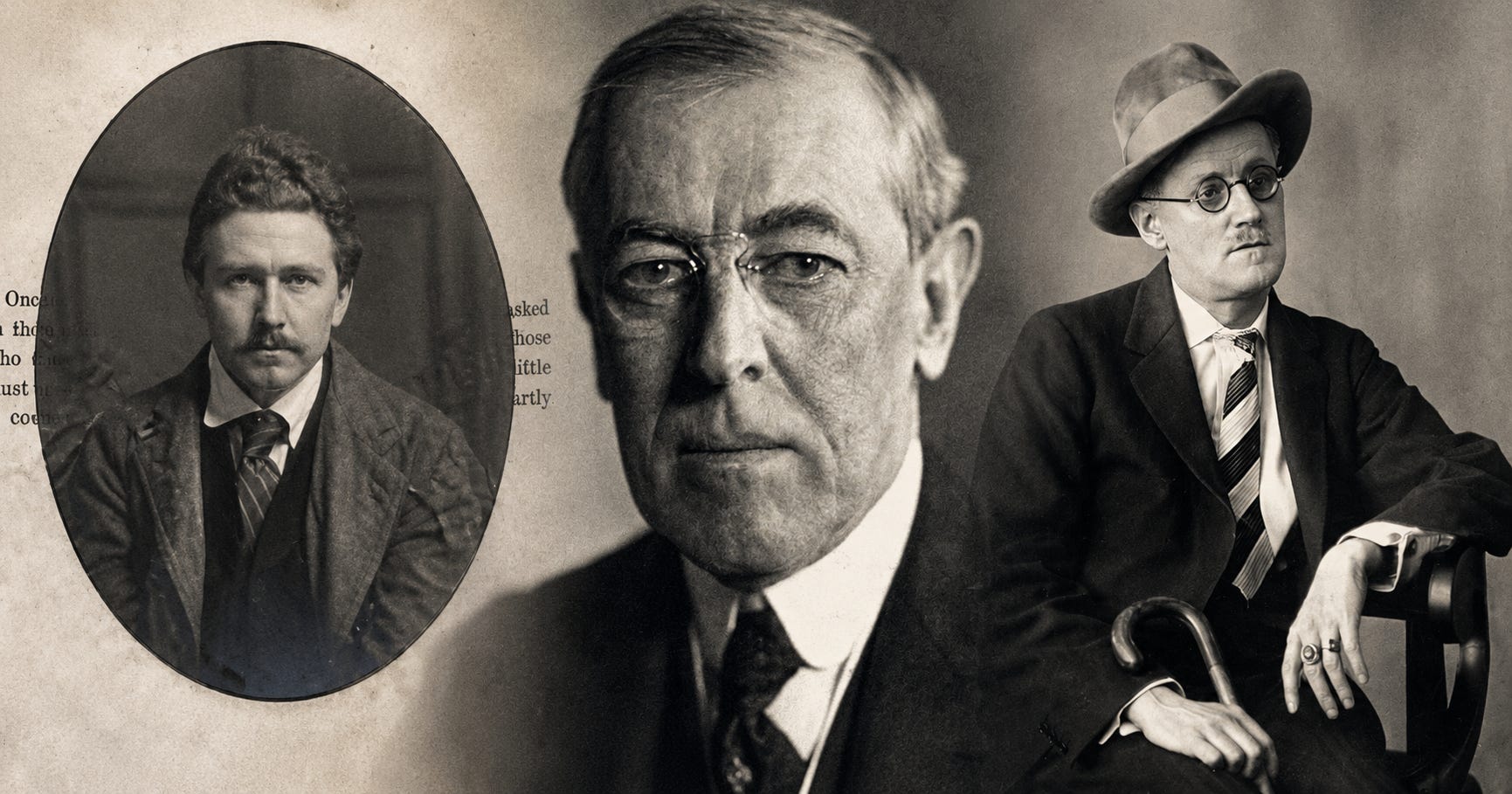
– Meh, Bloomsday was yesterday. This is June 17 already. Back to my point. I am contemplating the words of Ezra Pound on Joyce in 1922, in which he suggests that having writers as precise with words as Joyce before Woodrow Wilson died in 1921 might have saved “America and Europe” from Wilson. In fact, he implies, from the writing of Wilson.
– From the writing of Wilson?'
– Yes. “Far be it from me…” P’ound said, “to disparage the public utility of accurate language which can be attained only from literature, and which the succinct J. Caesar, or ’the lucid Macchiavelli, or the author of the Code Napoleon, or Thos. Jefferson, to cite a local example, would have in no ways despised.”
– I see. He was talking about the writing of political leaders, and its impact.
– And he happens to be naming leaders who attempted literature in other genres than political writing, like Caesar who wrote poetry or Napoleon Bonaparte who wrote a novel. That’s a recurrent subject on this blog.
– Go on.
– Then Pound says: “Of course it is too soon to know whether our present ruler”—he meant Warren G. Harding, who was president at the time—“takes an interest in these matters; we know only that the late pseudo-intellectual Wilson did not, and that the late bombastic Teddy did not, and Taft, McKinley, Cleveland, did not, and that, as far back as memory serves us no American president has ever uttered one solitary word implying the slightest interest in, or consciousness of, the need for an intellectual or literary vitality in America.
– Actually Wilson wrote an essay while a college professor called “Mere Literature” that made a similar argument, didn’t he?
– Yes. A philologist addressing a class of Wilson’s brother-in-law while the future president was a PhD candidate at John Hopkins University referred to “mere literature,” comparing literary writing unfavorably to scientific writing, and it set off the young Woodrow Wilson. He allegedly told a classmate, “I’ll get even with him!” So he wrote a highly successful book of essays arguing for an attention to style in educational writing. Which is ironic, because it’s style Pound accused Wilson of lacking. Here’s the kicker in Pound’s piece:
“A sense of style could have saved America and Europe from Wilson; it would have been useful to our diplomats. The mot juste is of public utility. I can’t help it. I am not offering this fact as a sop to aesthetes who want all authors to be fundamentally useless. We are governed by words, the laws are graven in words, and literature is the sole means of keeping these words living and accurate.”
– Well that’s well enough said. But, of course, Pound ended up going to Italy and supporting Mussolini, voicing support for Adolph Hitler of all people, and then being prosecuted for treason in the United States. Why are we quoting this guy again?
– It’s Bloomsday. The single day on which all 900 pages of Ulysses takes place, named for the lead character of the novel, Leopold Bloom.
– Bloomsday was yesterday.
– I have a theory about Woodrow Wilson and Ulysses.
– A theory? Like Stephen Daedalus in “Scylla and Charybdis”? Do you believe it?
– No.
– I thought not. Well let’s hear it?
– Having the world run by a writer, Woodrow Wilson, who allowed censorship of all other writers who dissented from his world war, ultimately gave way to the necessity of a new interior style of writing that acknowledged the paucity of truth in the surface layer of communication by revealing a vast teeming consciousness underneath that thought what could not be said. Hence Ulysses and Virginia Woolf and the entire modernist movement.
– That is ridiculous.
– Yes, yes, of course it is. But it feels true. It’s almost as if Wilson’s own writing style, cascading as it was with its own verbosity, squelched the vibrancy of all other writers until he died.
– Is that some kind of compliment to Wilson?
– No, it’s not a compliment. In my opinion Wilson’s style could be charming but quickly becomes wearisome. Have you ever tried to cut a Wilson speech? The sentences are long and complicated. But the fact is Wilson did directly control the words of writers who disagreed with him. His postmaster general actively banned from the mails all publications that opposed Wilson’s point of view on the war. In other words, those who used different terms than he did to talk about the war. One of these publications was written in part by John Reed, the writer famously played by Warren Beatty in the movie Reds. He wrote Wilson and tried to appeal to his generosity as a writer, “as friends of yours, and knowing how dear to you is the Anglo-Saxon tradition of intellectual freedom.” Wilson forwarded the letter to his postmaster with a message saying “These are very sincere men and I should like to please them.” But the postmaster rejected the idea they should be allowed to mail their dissent to the war and Wilson did nothing after all to stop it. Meanwhile Wilson was (as Harold Lasswell put it in 1927) the “great generalissimo on the propaganda front.” Thus in a sense one had to speak like Woodrow Wilson — making the world safe for democracy, the full propagandistic regimen — or not at all.
– But that hardly explains modernism, which began before Wilson was in office, and in Europe.
– Woolf said character changed in December 1910, which is just after Woodrow Wilson found out he was switching to politics from academia. He was elected governor of New Jersey in November 1910.
– Yeah, something tells me that is not what Woolf was talking about. George V took over from Edward VII in May of that year, that probably has more to do with it. And what does this have to do with Ezra Pound?
– In his writings in the 1920s Ezra Pound repeatedly danced around this notion that Wilson set the tenor of the times with his writing and that the world was not better for it. The footnotes of the Ezra Pound Cantos Project, a web site which annotates his poetry, says:
“Pound had a few important grudges against Wilson: the fact that he had involved the United States in WWI too late; the rise of bureaucracy, especially passports; and the wooden official language. Pound believed that “Le style c’est l’homme” and that the character of a person is discernible in the way the person talks and writes.”
– The way a person talks and writes, maybe. But not the way the rest of the culture talks or writes. He said Wilson’s writing was wooden? What’s the source for that?
– Ezra Pound’s Letters to His Parents. The relevant page includes the following quote:
“I intended Cantos XIV and V to give an accurate picture of the spiritual state of England in the years 1919 and following. Including Mr Wilson. They were written before the Harding Coolidge period, or I shd. have devoted a line or two to the mushiness of the former and the cant of the latter.”
– The mushiness of Wilson and the cant of Harding and Coolidge?
– Right. He goes on:
“Coolidge writes better than Woodie, but the common sense bluff or pose can be as bad almost as the mealymouthed blah. It is more efficient, a better implement. The silliness and triviality of the murkn mind. (sic.) Woodie so conceited he didn’t feel it necessary to know anything about Europe. Cal, ditto re economics.”
– So Wilson’s writing was a mealymouthed blah to Ezra Pound.
– Right. And this is what Pound had to say about that elsewhere, in his How to Read:
“The governor and legislator cannot act effectively or frame his laws, without words, and the solidity and validity of these words is in the care of the damned and despised literati. When their work goes rotten–by that I do not mean when they express indecorous thoughts—but when their very medium, the very essence of their work, the application of word to thing goes rotten, ie., becomes slushy and inexact, or excessive or bloated, the whole machinery of social and of individual thought and order goes to pot. This is a lesson of history, and a lesson not yet half learned.”
– Well, there’s a case against your whole blog.
– Thanks.
– But Wilson was not a horrible writer. The fact that he was so successful with propaganda, getting the whole world including Germany at one point in 1919 to call for his leadership makes his writing hard to argue with.
– Yes, the editors of the Cantos Project said “Pound’s opinion diverged from that of ordinary Americans, for whom the rhetoric of Wilson’s propaganda had been very effective.” Then they quote a paper by Matthew Kibble entitled “Modernism and the Daily Mail” from the journal Literature & History in 2002: “Woodrow Wilson’s speeches had been hugely successful in bringing American sympathy behind the idea of entering the war; his declaration of the ‘Fourteen Points’ which the USA was fighting to defend showed that Wilson had learnt the power of brief arresting statements from recent developments in advertising.” But the point is that he was so successful at propaganda that in a sense it controlled how people could talk.
– So after he died literature exploded. TS Elot’s The Waste Land and Virginia Woolf’s Jacob’s Room and of course Ulysses all appeared the year after he was gone.
– You’re getting the hang of this. Correlation equals causation.
– You gave up trying to sound like Joyce in the first paragraph, by the way.
– Never really tried. Pound said it’s impossible to imitate Joyce. He wrote: “Ulysses is, presumably, as unrepeatable as Tristram Shandy; I mean you cannot duplicate it; you can’t take it as a “model,” as you could Bovary; but … it does add definitely to the international store of literary technique.”
– So did Woodrow Wilson. For better or for worse.